

- Why Study Abroad ?
- Choose Your Course & Country
- How to Apply
- After Receiving Offer Letter
- Pre-Departure Guide
- Arrive & Progress
Why Study Abroad?
Thinking about studying overseas? You’re making a decision that can shape much more than your education.
Studying abroad gives you the opportunity to experience a new academic environment, meet people from different backgrounds, develop valuable skills, and prepare yourself for an increasingly global career.
Whether your goal is to earn an internationally recognized qualification, gain practical experience, explore a new culture, or build an international career, choosing the right study destination can open exciting possibilities for your future.
At Liberty Immigration Consultants, we help students understand those possibilities and choose study options that match their academic background, career ambitions, budget, and long-term plans.
The Benefits of Studying Abroad
1. Access Quality Education
Studying overseas can give you access to internationally recognized universities, specialized programs, modern facilities, and different approaches to teaching and learning.
Many institutions offer programs designed around current industry needs, allowing students to develop both academic knowledge and practical skills.
You can explore a wide range of fields—from business, engineering, IT, healthcare and hospitality to arts, design, science and many other specialized areas.
The key is finding a course that matches your interests today and supports your career goals for tomorrow.
2. Build a Global Career
Today’s employers increasingly value candidates who can communicate effectively, adapt to change, work with diverse teams, and understand different perspectives.
An international education can help you develop these qualities.
Depending on your destination and course, you may also have opportunities for:
- Industry placements and internships
- Practical and project-based learning
- Networking with international professionals
- Career development programs
- Exposure to international workplaces
- Developing communication and teamwork skills
Your overseas education can become an important part of your professional story and help you stand out in an increasingly competitive employment market.
3. Develop Independence and Confidence
Living in another country is a learning experience beyond the classroom.
From managing your daily responsibilities to navigating a new city, communicating with people from different backgrounds, and adapting to unfamiliar situations, studying abroad encourages you to become more independent.
You’ll learn how to:
- Make decisions with confidence
- Manage your time and responsibilities
- Solve problems independently
- Adapt to new environments
- Communicate across cultures
- Become more self-reliant
These are valuable life skills that can benefit you long after you graduate.
4. Experience a New Culture
One of the most rewarding aspects of studying abroad is experiencing everyday life in another country.
You can discover new traditions, cuisines, celebrations, languages, lifestyles and perspectives while becoming part of a diverse student community.
Meeting people from different countries can challenge your assumptions, broaden your perspective and help you understand the world from different points of view.
You don’t simply visit another country—you get the opportunity to live, learn and experience it.
5. Expand Your International Network
Your university or college can become the starting point for a truly international network.
You’ll meet classmates, lecturers, professionals and friends from different parts of the world. These relationships can enrich your student experience and potentially become valuable professional connections in the future.
Your international network may introduce you to new ideas, collaborations, career opportunities and friendships that last for years.
6. Improve Your Communication and Language Skills
Studying in an English-speaking environment can provide regular opportunities to practice your English in real-life situations.
You’ll use English not only in the classroom but also when communicating with classmates, lecturers, employers, service providers and people in your local community.
Over time, this everyday exposure can help you become more comfortable communicating in academic, professional and social settings.
If English-language proficiency is required for your chosen course, Liberty Immigration Consultants can also help you understand the relevant entry requirements and plan your preparation.
7. Discover New Interests
Moving abroad can encourage you to step outside your usual routine and try something different.
You might discover a new hobby, join a university society, participate in sports, volunteer in your community, attend cultural events or explore an interest that you never had the opportunity to pursue at home.
Your study abroad experience can become a time to discover not only a new country, but also new possibilities for yourself.
8. Explore Your Destination
Studying abroad gives you the chance to experience your destination beyond the university campus.
Depending on where you study, you may have opportunities to explore cities, natural attractions, cultural sites and local communities during weekends, holidays and study breaks.
From the diverse cities of the UK, USA and Canada to the unique landscapes and lifestyles of Australia, New Zealand and Ireland or culture-reach destinations in European countries like Belgium, Finland, Sweden and more, every destination offers its own experience.
The important thing is to choose a destination that fits your education, lifestyle, finances and future plans.
Can Studying Abroad Help With Your Future Immigration Plans?
For some students, international education may form part of a longer-term plan to gain professional experience overseas.
However, studying abroad does not automatically guarantee a work visa, permanent residency or migration outcome. Immigration pathways, post-study work rights and eligibility requirements vary by country and can change over time.
That’s why it is important to consider your future plans when selecting your destination and course.
At Liberty Immigration Consultants, we can help you understand the relationship between your study plans and applicable visa pathways, while keeping your decisions aligned with the current rules and requirements of your chosen destination.
Choose Your Course & Country
Find the Right Destination, Course & University for Your Future
Choosing to study abroad is exciting—but with thousands of courses, universities and destinations available, deciding where to study and what to study can feel overwhelming.
The right choice isn’t necessarily the country with the highest university ranking or the course that everyone else is choosing. Your ideal study destination should match your academic background, career ambitions, financial situation, lifestyle preferences and long-term goals.
At Liberty Immigration Consultants, we help you explore your options and make an informed decision about your international education journey.
Start With Your Goals
Before searching for universities, take some time to understand what you want from your overseas education.
Ask yourself:
- What subjects or careers interest me?
- What qualification do I want to earn?
- Which industries offer opportunities in my chosen field?
- Do I prefer practical or research-focused education?
- What is my available budget?
- Which countries offer suitable programs?
- What are my long-term career goals?
Having clear answers to these questions makes it much easier to narrow down your choices.
1. Choose the Right Study Destination
Every country offers a different education system, lifestyle and student experience.
When comparing destinations, consider:
Education Quality: Look at the reputation of the country’s education system, institutions and programs.
Course Availability: Some destinations may offer stronger options for particular subjects or specializations.
Tuition & Living Costs: Don’t look at tuition fees alone. Consider accommodation, transportation, food, insurance, study materials and other living expenses.
Lifestyle: Think about climate, city size, culture, transportation, accommodation and the overall environment in which you would feel comfortable living.
Career Opportunities: Research whether your chosen destination offers opportunities relevant to your field after graduation, subject to the applicable laws and visa conditions.
Entry & Visa Requirements: Different countries and institutions have different academic, English-language, financial and visa requirements.
Choosing a destination should be about finding the right overall fit—not simply choosing the most popular country.
2. Decide What to Study
Your course is one of the most important decisions you’ll make.
If you already have a clear career goal, start by researching programs that can help you reach it.
If you’re still deciding, consider:
- Your favorite subjects
- Your academic strengths
- Your previous qualification
- Your interests
- Potential career paths
- Industry demand
- Future specialization opportunities
Popular areas of international study include:
Business & Management | Accounting & Finance | Information Technology | Engineering | Healthcare | Nursing | Hospitality & Tourism | Education | Social Sciences | Design & Creative Arts | Data & Computing
Don’t select a course solely because it is popular. A good course should make sense for your academic history and future plans.
3. Choose the Right Study Level
Your previous education will influence the type of program you can apply for.
Depending on your academic background, you may consider:
- Foundation programs
- Diploma programs
- Undergraduate degrees
- Graduate certificates or diplomas
- Master’s degrees
- Research degrees
- PhD programs
- Professional or vocational programs
Understanding the progression between qualifications can help you create a realistic education pathway.
4. Compare Universities Carefully
Once you’ve identified your preferred course and destination, compare institutions.
Look beyond rankings and consider:
- Course structure
- Modules and subjects
- Teaching approach
- Accreditation
- Research facilities
- Industry connections
- Internship or placement opportunities
- Campus facilities
- Location
- Accommodation
- Student support
- Tuition fees
- Scholarships
A university that is highly ranked may not necessarily be the best fit for your particular course, budget or career objective.
The best university for you is the one that fits your overall study plan.
5. Understand Your Total Budget
Planning your finances early can prevent problems later.
Your study abroad budget may include:
Tuition fees + accommodation + food + transportation + health insurance + visa costs + flights + study materials + personal expenses
Also research scholarships, grants and other funding options that may be available for eligible students.
At Liberty Immigration Consultants, we can help you understand the costs associated with your chosen study destination so you can plan your education more realistically.
Make the Right Choice With Liberty Immigration Consultants
You don’t have to make your study abroad decision alone.
Our counselors can help you compare destinations, courses and universities based on your individual profile and goals.
Ready to find your best study option?
Talk to Liberty Immigration Consultants and start building your study abroad plan today.
How to Apply to Study Abroad
Turn Your Study Plan Into a University Application.
Once you’ve decided where and what you want to study, it’s time to turn your plans into an application.
Applying to an overseas university involves more than completing an online form. You’ll need to understand the admission requirements, prepare supporting documents, meet language requirements and submit your application correctly and on time.
At Liberty Immigration Consultants, we help students navigate each stage of the application process with greater clarity and confidence.
Step 1: Check Your Eligibility
Every university and course has its own admission requirements.
These may include:
Academic qualifications
Minimum grades
Relevant subjects
English-language proficiency
Work experience
Portfolio requirements
Entrance examinations
References
Personal statements
Requirements can differ between institutions, even for similar courses.
Before applying, make sure your academic profile meets the requirements of your chosen program.
Step 2: Prepare Your Documents
Depending on your course and destination, you may need documents such as:
Passport
Academic certificates
Academic transcripts
English-language test results
CV or résumé
Statement of Purpose
Personal statement
Letters of recommendation
Employment documents
Portfolio
Financial documents
Other supporting evidence
Make sure your documents are accurate, complete and consistent.
If documents are not in the required language or format, additional procedures such as certified translations may be necessary.
Step 3: Meet the English-Language Requirement
Many universities require international students to demonstrate English-language proficiency.
Depending on the institution and course, accepted tests may include IELTS, PTE Academic, TOEFL or other approved assessments.
The required score can vary depending on:
University
Course
Degree level
Faculty
Destination
Student background
Check the exact requirement for your chosen program rather than assuming that one score applies everywhere.
Step 4: Prepare a Strong Personal Statement or SOP
Some universities ask applicants to submit a personal statement or Statement of Purpose.
This is your opportunity to explain:
Why you chose the course
Why you selected the institution
How your previous education relates to the program
Your career goals
What you hope to gain from the program
Why you are prepared for the next stage of your education
Your statement should be genuine, relevant and based on your own experiences and goals.
Step 5: Submit Your Application
Once your documents are ready, submit your application according to the university’s requirements.
Depending on the institution, applications may be submitted directly to the university or through an authorized application system.
Before submitting, check:
✓ Personal information
✓ Academic history
✓ Course selection
✓ Supporting documents
✓ English test results
✓ Personal statement
✓ Application deadlines
A small error or missing document can cause unnecessary delays.
Step 6: Track Your Application
After submission, keep an eye on your email and application portal.
The university may:
Request additional documents
Ask for clarification
Invite you to an interview
Request evidence
Issue a conditional offer
Issue an unconditional offer
Decline the application
Respond to requests promptly and keep copies of your correspondence.
How Liberty Immigration Consultants Can Help
The application process can be complicated, particularly when you’re applying to multiple institutions.
Our team can help you with:
Course & university selection
Application preparation
Document guidance
Personal statement guidance
Application submission support
Offer communication
Pre-visa preparation
We aim to make your application journey organized, transparent and easier to manage.
Ready to apply?
Speak with Liberty Immigration Consultants and take the next step toward your international education.
After Receiving Offer Letter from the Institute
Your Offer Is Here. What Happens Next?
Receiving an offer from a university is an exciting milestone.
But your journey doesn’t end when the offer arrives. There may be several important steps to complete before you can begin your studies.
Your offer could be conditional or unconditional, and understanding the difference is essential.
At Liberty Immigration Consultants, we help students understand their next steps and prepare for the transition from university admission to visa application.
Understand Your Offer Letter
Read your offer carefully before accepting it.
Pay attention to:
Course title
Start date
Course duration
Tuition fees
Deposit requirements
Conditions of the offer
Deadline for acceptance
Required documents
English-language conditions
Other academic requirements
If you don’t understand something, seek clarification before making a commitment.
Conditional vs Unconditional Offers
Conditional Offer
A conditional offer means you still need to meet one or more requirements before your admission becomes final.
For example, you may need to:
Provide a final academic certificate
Achieve a required grade
Submit an English-language test result
Provide additional documentation
Complete another admission requirement
Unconditional Offer
An unconditional offer generally means the institution has confirmed that you have met its admission conditions.
However, you should still carefully review the terms and instructions provided by the institution.
Accept Your Offer
Once you have decided that the course and institution are right for you, follow the university’s instructions to accept the offer.
You may need to:
Accept the offer
Complete required forms
Pay a deposit or tuition amount
Submit outstanding documents
Complete enrollment requirements
Keep confirmation of every important transaction and communication.
Receive Your Enrollment Documents
After completing the required steps, your institution may issue documentation needed for your enrollment and/or visa application.
The exact documents and terminology vary by destination.
Your counselor can help you understand what documentation you should expect and what you need to do next.
Prepare for Your Student Visa
Once your admission and enrollment requirements are in place, you can move on to your student visa preparation.
Visa applications may require evidence relating to:
Identity
Admission or enrollment
Financial capacity
Health insurance
Academic background
English proficiency
Genuine study intentions
Other destination-specific requirements
Visa requirements can change, so always work with the current requirements for your destination.
What If You Receive Multiple Offers?
Congratulations—you have options!
If you receive offers from multiple institutions, compare them carefully. Consider:
Course content
Total cost
Location
University environment
Career relevance
Accommodation
Available support
Future study or career plans
The cheapest option isn’t always the best, and the most famous university isn’t necessarily the right fit.
Choose the option that makes the most sense for your goals and circumstances.
Your Next Step With Liberty Immigration Consultants
An offer letter is a major milestone, but there are still important decisions ahead.
Liberty Immigration Consultants can guide you through the next stage—from understanding your offer to preparing for your student visa and departure.
Received your university offer?
Let us help you take the next step with confidence.
Pre-Departure Guide
You’ve chosen your course, received your offer and completed your visa process.
Now it’s time to prepare for the big move.
Traveling to another country for the first time can feel exciting and a little overwhelming. Good preparation can make your arrival much smoother and help you focus on settling into your new student life.
At Liberty Immigration Consultants, we help students prepare for the practical side of moving overseas.
Your Pre-Departure Checklist
1. Organize Your Important Documents
Keep your important documents organized and accessible.
These may include:
Passport
Student visa
University offer letter
Enrollment documentation
Flight information
Accommodation confirmation
Health insurance documents
Academic documents
Emergency contact information
Financial documents
Keep digital backups of important documents in a secure location.
2. Arrange Your Accommodation
Don’t leave accommodation planning until the last minute.
Depending on your destination and institution, options may include:
University accommodation
Purpose-built student accommodation
Private rental
Home-stay
Shared accommodation
Consider:
Distance from campus | Cost | Transport | Safety | Facilities | Contract terms | Location
Make sure you understand the terms of your accommodation agreement before committing.
3. Plan Your Travel
Check your flight details carefully and plan how you will get from the airport to your accommodation.
Before departure, know:
Your arrival airport
Arrival date and time
Accommodation address
Airport transfer options
Local transportation options
Emergency contact details
Having this information ready can make your first few hours in a new country much easier.
4. Plan Your Finances
Create a realistic budget before you leave.
Consider your:
Tuition payments
Accommodation
Food
Transportation
Phone and internet
Study materials
Insurance
Personal expenses
Emergency funds
Understand how you’ll access your money overseas and keep some funds available for your initial expenses.
5. Understand Your Destination
Before traveling, learn about your new country and city.
Research:
Local transport
Weather
Public holidays
Local customs
Important laws and regulations
Healthcare arrangements
Emergency procedures
University support services
Understanding your surroundings before you arrive can help reduce the stress of settling in.
6. Pack Smart
You don’t need to pack your entire life into your suitcase.
Prioritize:
Important documents
Essential medicines and permitted personal items
Appropriate clothing
Electronic devices and chargers
Study essentials
A few familiar personal items
Check your destination’s customs and entry requirements before packing anything that may be restricted.
7. Prepare Mentally for the Move
Moving abroad is a major life change.
You may feel excited, nervous, homesick or uncertain at different points. That’s normal.
Stay connected with your family and friends, but also give yourself time to build a new routine.
Remember that adjusting to a new country doesn’t happen overnight.
Your Liberty Immigration Consultants Pre-Departure Support
We want your journey to continue smoothly after your visa approval.
Our team can provide guidance on practical matters such as:
Accommodation
Travel preparation
Financial planning
Insurance
Essential documents
Arrival preparation
Student life overseas
Almost ready to fly?
Speak with Liberty Immigration Consultants before departure and make sure you’re prepared for your next chapter.
Arrive & Progress in Your Study Abroad Life
Welcome to Your New Chapter. You’ve made it.
After months of researching universities, preparing applications, receiving your offer, completing your visa process and getting ready to travel, you’ve finally arrived at your study destination.
Now the real adventure begins.
Your first few weeks may involve plenty of new experiences—from finding your way around campus to meeting new people and adapting to a different culture.
Take your time. You don’t need to figure everything out on day one.
Your First Steps After Arrival
1. Settle Into Your Accommodation
Once you arrive, make sure you understand:
Your accommodation rules
Rent and payment arrangements
Internet access
Laundry facilities
Transport options
Emergency procedures
Local amenities
If you are staying in shared accommodation, take the opportunity to meet your housemates and establish a comfortable routine.
2. Complete Your University Orientation
Attend your university’s orientation or induction activities.
These sessions can introduce you to:
Your campus
Academic departments
Student support services
Library facilities
Clubs and societies
Academic expectations
Health and well being services
Careers services
Important university policies
Orientation is also one of the easiest ways to start meeting other students.
3. Understand Your Academic Environment
Education systems can vary significantly between countries.
You may encounter different approaches to:
Class participation
Assignments
Group projects
Examinations
Independent research
Referencing
Attendance
Communication with lecturers
Don’t hesitate to ask your university for help if you’re unsure about something.
4. Build Your Community
Making friends can make your overseas experience much more enjoyable.
Consider joining:
Student societies
Sports clubs
Cultural organizations
Volunteer activities
University events
International student groups
Be open to meeting people from different backgrounds.
Some of the most valuable parts of studying abroad happen outside the classroom.
5. Learn to Manage Your Time
University life comes with more independence—and more responsibility.
Create a routine that allows time for:
Classes + assignments + revision + work (where permitted) + exercise + social activities + rest
Good time management can help you enjoy your student experience without becoming overwhelmed.
6. Look After Your Finances
Keep track of your spending after arrival.
Create a monthly budget covering:
Accommodation
Food
Transportation
Study expenses
Phone and internet
Entertainment
Emergency expenses
Small daily expenses can add up quickly, so learning to manage your money early can make a big difference.
7. Explore Your New Home
Don’t spend your entire study experience inside the campus.
Explore your city, visit local attractions, try new activities and learn about the culture around you.
At the same time, remember that you are living in another country and should respect local laws, customs and community standards.
8. Take Advantage of Student Support
If you’re struggling academically, socially or practically, ask for help.
Universities often provide services such as:
Academic support
Careers guidance
International student services
Counseling and well being support
Library assistance
Disability support
Accommodation support
Asking for help is not a weakness. Knowing where to find support is an important part of becoming an independent student.
Make the Most of Your Study Abroad Experience
Studying overseas is about much more than earning a qualification.
It’s an opportunity to:
Learn
Explore
Connect
Adapt
Grow
Build your future
Give yourself permission to experience the highs and challenges of life abroad. Every new experience can teach you something valuable.
Liberty Immigration Consultants Is With You Beyond the Visa
Our relationship with students shouldn’t end when your visa is approved.
At Liberty Immigration Consultants, we want to help you prepare for the entire study abroad journey—from your first consultation to your departure and beyond.
Ready to begin your international education journey?
Start with Liberty Immigration Consultants today.
Why Choose
Liberty Immigration Consultants?
Our team of seasoned professionals understands the complexities of eligibility, admission and visa procedures.
Career Counseling
Choosing the right visa agency can make a world of difference in your journey toward international exploration, growth, and success.
Get Free CounselingUniversity Admission
Choosing the right visa agency can make a world of difference in your journey toward international exploration, growth, and success.
Check your eligibilityVisa Assistance
Choosing the right visa agency can make a world of difference in your journey toward international exploration, growth, and success.
Get Free CounselingScholarship Guide
Choosing the right visa agency can make a world of difference in your journey toward international exploration, growth, and success.
Check Your EligibilityDocument Support
Choosing the right visa agency can make a world of difference in your journey toward international exploration, growth, and success.
Check RequirementsFinancial Planning
Choosing the right visa agency can make a world of difference in your journey toward international exploration, growth, and success.
Get Free CounselingIELTS / PTE / Duolingo
Choosing the right visa agency can make a world of difference in your journey toward international exploration, growth, and success.
Check the GuidelinePre-Departure Guide
Choosing the right visa agency can make a world of difference in your journey toward international exploration, growth, and success.
Get Free CounselingCommon Questions
Answered
Find quick, clear answers to your most common questions about the student visa process, university applications, and document requirements. We break down the complexities of studying abroad so you can plan your journey with total confidence.

-
How much do you charge for study abroad applications and student visa processing?
Liberty Immigration Consultants does not charge any application or student visa processing fees for eligible partner universities. We provide free education counseling, university admission guidance, application support, and student visa assistance for students planning to study abroad from Bangladesh. Terms and conditions may apply.
-
Which countries can I apply for higher education?
We help students from Bangladesh apply to top universities in Canada, the UK, USA, Australia, New Zealand, Finland, Belgium, Malaysia, South Korea, Malta, and other European countries, leading study abroad destinations. We support applicants for Bachelor's, Master's, and postgraduate programs.
-
Can I study abroad with a study gap?
Yes. Many universities accept students with a study gap based on their academic background, work experience, and supporting documents. Our experienced education counselors will review your profile and recommend the most suitable study abroad options.
-
What study abroad services does Liberty Immigration Consultants offer?
We provide complete study abroad services, including free counselling, university and course selection, scholarship guidance, university admission support, application processing, document preparation, student visa assistance, pre-departure guidance, and post-arrival support where available.
-
Can I study abroad from Bangladesh without IELTS?
Yes. Many universities accept Bangladeshi students without IELTS by considering alternatives such as MOI, PTE Academic, TOEFL iBT, Duolingo English Test, or university-approved English assessments. Eligibility depends on the university and destination country.
-
Are scholarships available for international students?
Yes. Many universities offer scholarships for international students based on academic performance, merit, or other eligibility criteria. Our counselors help eligible students explore scholarship opportunities and guide them through the application process.
-
Can international students work while studying abroad?
Yes. All study abroad destinations allow international students to work part-time during their studies, subject to local immigration regulations and student visa conditions. The number of working hours varies by country.
-
How can I start my study abroad application?
Getting started is simple. Complete our online assessment form or contact Liberty Immigration Consultants for a free consultation. Our education counselors will assess your profile, recommend suitable universities, and guide you through the university admission and student visa process.
Related Articles & Resources

 By Liberty
- 22 October 2025
 By Liberty
 22 October 2025
Study in New Zealand — 2026 Intake Now Open! Your Bright Future
Read the article
- By Liberty
- 22 October 2025
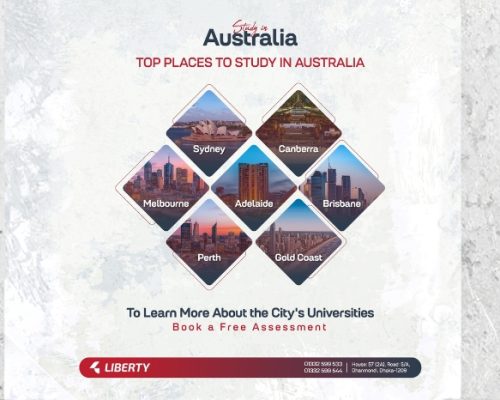
Study in Australia — Bangladesh Now Level 1! Your Student Visa Journey
Read the article

- By Liberty
- 22 October 2025
Dreaming of Studying in the UK? The University of Huddersfield Awaits —
Read the article